Translate

Thursday, 8 September 2016

Mr. Draghi's Transmission Mechanism of Monetary Policy


The European Central Bank's Governing Council in its September meeting kept the monetary policy unchanged  leaving  the main refinancing rate at zero, the deposit rate at minus 0.4 per cent and asset purchases at 80 billion euros ($90 billion) a month. Following the familiar pattern of revising down the optimist projections by the IMF and other central banks, the ECB also lowered its growth forecast for 2017, to 1.6 per cent from 1.7 per cent and revised down its inflation forecast for 2016, to 1.2 per cent from 1.3 per cent.

In spite of negative interest rates and quantitative easing, eurozone's growth slowed to 0.3 per cent in the second quarter, from 0.5 per cent  in the first quarter, and headline inflation remained unchanged in August at 0.2 per cent, reflecting in part the lagged effects of oil prices. Furthermore, core, or underlying inflation rate that excludes energy, food, alcohol and tobacco was also lower, at 0.8 per cent in August, as compared to 0.9 per cent in the previous month.


ECB Balance Sheet, Total Assets €3,330,487 mn.


Euro Area Headline Inflation Rate
Euro Area Core Inflation Rate


Inflation has been close to zero since the late 2014 and in fact below 1 per cent since the late 2013. In other words, assuming an upward measurement error,  of the kind discussed by Bernanke and Mishkin (1997) and Camba-Mendez (2003),  of say 0.5 per cent, then one may maintain the hypothesis that eurozone has been very close to a deflationary mode over the past few quarters. The region grew by just 1.6 per cent in 2015 with much of the expansion deriving from the ECB's purchase of more than €1 trillion ($1.1 trillion) of securities so far,  which  has diminished bond yields to abnormally low levels.

While acknowledging that the current negative interest rate introduces challenges for the policy makers, Mr. Draghi suggested that:
Right now the transmission mechanism is really working very well. It's never worked better.
It is very hard to validate this assertion in a market which agents,  in the optimization of their objective  functions, are able to take account of the possible policy actions.  In fact, the transmission mechanism has been disrupted at various critical connections precisely because of this ability and this is why the forecasting models that  central banks are using  are persistently overpredicting the economy's growth rates and why investors are reluctant to invest.

The  ECB’s ability to stimulate aggregate demand by lowering interest rates and devaluing euro has been seriously undermined by the disruption in the transmission mechanism as bond holders prefer to hold on to their bonds despite the fact that an estimated 28 per cent of Eurozone bonds' yields are lower than the deposit rate and  52 per cent of its government bonds  are yielding negative returns. The comparable figures  for German bonds are  66 per cent  and about 85 percent.  Of course, part of the excess demand for bonds stems from the QE's rules that restrict the ECB purchases to  only one third of most bond issues and any bonds yielding less than minus 0.4 per cent.   The rules also restricts the scale of purchases in each country to the size of its economy in the eurozone. For instance in Germany this amounts to  a monthly purchase  of about  €10bn of government debt. Nevertheless, because of excess demand for the German government deb their prices have increased  and more than half  of the country's bonds are now yielding less than the  minus 0.4 per cent which excludes them from the QE.

Mr Draghi maintained that for the time being, the ECB's downward revisions are not substantial enough to warrant a change in policy, and despite the distortionary impacts of the negative interest rates and QE,  he asserted that these policies have been "very effective", since:
While in the previous time we had observed fragmentation and very subdued credit developments, now we can say fragmentation is over and credit is growing constantly.
Of course, credit may be growing constantly, but because of the adverse selection problem this growing credit is not channeled into most productive ventures that could expand the economy's efficient production frontier. As theory envisages the high-risk borrowers are flooding the supply side  of the bond markets while the high quality borrowers are leaving the market because of the increased risk. As a result of getting into this slippery slope  some are now  suggesting the possibility  that ECB, like Bank of Japan, may be forced to purchase stocks. Mr. Draghi  expressed his determination to provide more stimulus if needed and reported that the  bank has asked staff members  to re-evaluate the design of the QE program,  which may hint  to the possibility of a widening of the program to include equities in order to circumvent  the bond shortages.

One has to ponder on the equity-based QE policy's extreme distortionary risks -- e.g.,  how the ECB would  choose among the winners and losers in various sectors and in various countries or would the bank be able to purchase  the promising startups' stocks with high  productivity prospects when the market information is plagued with high levels of noise in this climate of global uncertainty, or would the ECB be focusing on stock purchase  of the Too-Big-To-Fail corporations with low productivity prospects?  The number of such questions would be incredibly large. In any event, eurozone growth is expected to flatline over the next several years like those of many other advanced economies.

 In fact, the ineffectiveness of the ECB's non-conventional policies is already evinced by a recent ECB working paper    that suggests  that in recent years inflation expectations in the eurozone have shown some signs of de-anchoring,  implying  a loss of ECB's credibility due to the lack of information content in its inflation forecasts that has caused the professional forecasters to ignore the bank's inflation targets in their inflation expectations formation. The authors write:
Continuous analysis of de-anchoring risks is crucial in monetary policy, especially in the current low inflation environment. Monetary policy credibility is built gradually over the years, but we cannot rule out the possibility that it may deteriorate quite rapidly. 
When analysing anchoring of inflation expectations, we also need to examine when the inflation target is expected to be reached. Risks of de-anchoring are potentially increasing, if the time when the target will be reached has been postponed in economic agents’ expectations. 
As we have argued in the past, the slowdown of growth and policy ineffectiveness are global phenomena stemming from the current global financial imbalances, currency wars, and a fragile banking system, that are being exacerbated by the QEs and other unconventional policies. The fact that German and French business sentiment fell unexpectedly in August, especially among manufacturers, is another sign of the ECB's loss of credibility to deal with this global predicament.  Even the ECB's resort  to the currency war  has resulted in an upward pressure on euro due to generating a current account surplus that cannot be offset by outflow of the scarce capital from the region, due to the fragility of its banking system.


Euro Area Productivity

As the above chart indicates, the eurozone productivity growth  has slowed markedly over the post-recession period. The ever-so-slight  positive slope in the trend productivity of the recent years  has been basically concentrated in countries like France and Italy which have experienced a rise in their unemployment rates, indicating that the recent unemployeds in these countries have been mostly among the least productive labourers.  

In contrast, productivity growth has been stagnating in Germany,  a fully-employed economy with balanced public finances and a surging current account surplus of 9 percent of GDP.  Registering 1.8 per cent annual growth rate  in the first half of this year, German economy is running almost one percentage point above its potential and is attracting  inflow of funds from the low productivity countries. German GDP growth in the second quarter was tepid 0.4 per cent, down from a 0.7 per cent  in the first quarter and its business investment exhibiting the same wait-and-see pattern as the rest of the advanced economies.

Despite this anaemic productivity growth Mr. Draghi's advice to Germany, an export-reliant country, is that it must increase its unit labour cost by allowing wages to increase. He suggested that:
Countries who have fiscal space should use it. Germany has fiscal space.
But in today's circumstances  Germany's fiscal space has to be used to increase the productivity of eurozone's pripheries, otherwise it will be adding to imbalances.  However, this would imply a centrally planned model which would be destined to failure.

German Productivity


French Productivity


Italian Productivity

German Unemployment rate

French Unemployment Rate
Italian Unemployment Rate

In August 2015 we argued here in this forum that:
Consistent with Ben Bernanke’s option price of waiting it would be quite rational for businesses to postpone their strategic investment plans at times of currency wars and global volatility, and focus instead on their contingent capacity limits. Thus, business surveys instead of picking up reports of capacity utilization rates relative to the long term capacity associated with the firm’s minimum long-term average costs would detect signals of capacity tightening due to delays in implementation of irreversible phases of investment. This observation can also be validated by indicators such as investment profile and productivity growth. Note that productivity growth — defined as the rate of change of output minus rate of change of hour worked — will rise when investors invest to expand the production possibility frontier which usually would  reduce their cost structure through adoption of new innovative technologies.
Last February we argued here that:
It appears that central banks have forgotten a number of basic macroeconomic facts; 
i. The liquidity demand will become inelastic around the potential output, and potential output itself shrinks when there is no capital formation and plenty of uncertainty. Moreover, reducing the interest rate cannot affect the growth rate of real output when aggregate demand becomes insensitive towards changes in the policy rate. The conventional theory suggests that the impact of increased liquidity should be translated in higher inflation rates. However, this could be the case if and only if the newly created liquidity can enter into the markets, via consumption and investment which is not the case in today’s economic environment. One can argue that in today’s economy either central Banks have lost their ability to create liquidity, or to the extent that they are able to do so firms’ change of behaviour has offset it. In other words the liquidity created by central banks is hoarded by firms. Businesses are not investing, because they do not see a sustained level of increased demand, and negative interest rates cannot force them to invest because they have invented new instruments and innovative tactics in order to hoard liquidity.

ii. If central banks are aiming at a currency war, to increase their market share of exports, they must have forgotten that these wars worsen the already highly toxic trade environment. In fact, this is the classic case of ‘fallacy of composition”
It appears that in his Brussels Economic Forum lecture, on June 2016,  Mr. Draghi was agreeing  with that kind of analysis  and correctly acknowledging that;
There is also emerging evidence that growing below potential for too long can erode that potential through its effect on productivity growth. When uncertainty is high, a “wait-and-see” attitude can cause the most productive firms not to expand as much as they would otherwise. (...) The cost of delay, then, is that labour and productivity suffer, and the output gap closes in the “wrong way” – instead of output rising towards potential, it is potential that falls towards current output.

The same idea of wait-and-see has been supported by John Cryan, the chief executive of Deutsche Bank, in a recent commentary published in Germany's Handelsblatt newspaper stating that:
"companies are holding back due to the ongoing uncertainty with investments and are rarely requesting loans."

This is  a clear sign of a disruption in transmission mechanism. Europe is sliding fast toward a deep recession.


Thursday, 1 September 2016

On the discombobulating productivity growth slowdown


 In her  Jackson Hole lecture Ms. Yellen has stated:
Finally, and most ambitiously, as a society we should explore ways to raise productivity growth. Stronger productivity growth would tend to raise the average level of interest rates and therefore would provide the Federal Reserve with greater scope to ease monetary policy in the event of a recession. But more importantly, stronger productivity growth would enhance Americans' living standards.

As the following chart shows  labour productivity has been growing at a slower pace in recent years. Moreover,  according to the revised estimates by the US Labor Department nonfarm business productivity measured as the goods and services produced by American workers per hour, decreased at a 0.6 per cent seasonally adjusted annual rate in the second quarter. This was the sharpest year-on-year decline over the past three years.


US labor productivity in the nonfarm business sector

This  was also the third consecutive quarter of decline the longest slide in worker productivity since the late 1979. In terms of year-over-year change  labour productivity was down 0.4  per cent in the second quarter, the first annual decline in three years.

It is worth to remind ourselves that productivity is the denominator in the unit labour cost ratio, with the numerator being the real wage, meaning  higher productivity would increase the country's competitiveness by reducing the unit labour cost. When  prodctivity grows at the same pace as the real wage it offset the adverse impact of the latter on  a country's competitiveness in the export markets. Unit labor costs rose at a 4.3 per cent annual rate, a 2.6 per cent rise from a year ago, reflecting  in part a 1.1 per cent rise in real  hourly wage per hour in the second quarter.

The strong productivity growth exhibited in the chart in the late 1990s has been attributed to the investment surge in the information technology that resulted in a marked reduction of the unit labour cost, which  boosted the GDP growth.

The productivity slowdown of recent years, as we have persistently argued in this forum, emanates from the effects of the global financial imbalances and high levels of global indebtedness  that have caused high level of uncertainty, whereby  businesses  postpone their irreversible capital expenditures and shift to an intensive margin mode of production. As a result of weak investment the economy's production frontier has not expanded and thus productivity growth has shrunk. This is a global phenomenon , which has been affecting international trade, encouraging currency wars and  spreading  poverty. Lower production frontier and rising unit labour costs have also diminished corporate profits and has aggravated  the financial imbalances.

As we have argued in the past  a lower productivity arising from a prolonged shift towards intensive margin mode of production would lower the economy’s potential growth. Many central banks around the world have already lowered their expectations for future growth and interest rates, without acknowledging the high level of debts and a fragile financial system as the main culprit. The consequential  uncertainty acting as a barrier to capital formation has created a vicious circle towards a rapidly approaching stagflation.

We believe the  alternative hypothesis put forward to explain the  productivity slowdown cannot be maintained with a sufficient confidence. For instance, it is hard to believe that in spite of  the recent advances in high tech communication, smart materials,  Internet of Things, large scale sensor network applications,  Big Data, cloud computing, supply chains  so on and so forth a  secular trend  toward a more modest efficiency gains, as compared to past advances, has been emerged.

It is also difficult to maintain the hypothesis of errors in measurement of productivity when the global economy is clearly slowing down, and businesses are delaying their capital expenditure plans. In the US fixed nonresidential investment, which is comprises about twenty per cent the economy --  has declined for the past three quarters  and new orders for nondefense capital goods excluding aircraf has declined on a year-over-year basis almost continuously for the past year and a half.

The situation is not materially different in Europe and Asia. In fact, investments have exhibited the same pattern of decline as aggregate demand since the 2015. The situation has deteriorated fast since the early 2016. During the second quarter, total investments declined 3.4 percent from the year earlier, and subtracted 1.68 percentage points from the GDP growth.

As the following chart shows the total factor productivity, TFP, that captures the efficiency with which labor and capital are combined to generate output ,  over the past four quarters ending in the second quarter of 2016, has fell at a rate of minus 0.7 per cent while Utilization-adjusted Total Factor Productivity has fell at rate of minus 0.32 per cent. This is another  clear indication of a shift towards intensive margin mode of production. We have in the past examined other evidence in favour of uncertainty hypothesis deriving from financial imbalances and will not repeat the argument here again. Suffice to remind readers that a greater use of contingent labour in the current capacity planning by businesses has resulted in wages falling behind productivity growth.

Total Factor Productivity Rate (Four quarter per cent change in natural log) Source: FRBSF


Another evidence for greater use of contingent labor is the fact that in  addition to the officially reported 7.8 million people currently out of work, there are 8 million individuals in involuntary part-time jobs. Furthermore, there are the 2 million of long-term unemployed and another 2 million of virtually unemployable persons that their only hope for finding a job is through demand for contingent labour.

Getting some of these 16 million people back on the payrolls will require a major capital formation so as  generate a favourable shift in the aggregate labor demand which has been lacking. As well, the slowing international trade need to be boosted. It is of note that in the first six months of this year, the U.S. trade deficit was running at an annual rate of $712 billion. That negative trade balance accounts for 4 percent of the economy, and it is currently taking half a percentage point off the growth of the domestic demand. For aggregate demand to grow at a healthy pace the global financial markets need to return to equilibrium, excessive global debts have to be restructured, and currency wars must be ended.


Sunday, 28 August 2016

From Jackson Hole with Neutral Rate, Inflation Expectations, and Inflation Targets


 With interest rates around the world at close to zero or negative and another recession looming on the horizon central banks, having exhausted their firing powers with the so-called unconventional policies, appear rather anxious about the efficacy of their tools. This is why the Chair of the Federal Reserve, Janet Yellen, spent much of her speech at central bankers meeting in the mountain resort of Jackson Hole, Wyoming   trying to explore  the  effectiveness of Fed's expanded monetary policy toolkit.

Overall, it appears that Fed still thinks or hopes  that changes in nominal variables stemming from the conventional and unconventional policy tools such as changes in the Fed funds rate or Quantitative Easing will exert a lasting and  long-term impact on the real variables such as the real GDP growth rate in these financially  abnormal times. Ignoring the fact that the effectiveness of monetary policy tools has been seriously diminished in recent times at various advanced countries and abstracting from the distortionary effects of the unconventional tools on the economy, Ms. Yellen  primary message at Jackson Hole was that:

I expect monetary policy will continue to play a vital part in promoting a stable and healthy economy. New policy tools, which helped the Federal Reserve respond to the financial crisis and Great Recession, are likely to remain useful in dealing with future downturns.

There were hardly any new information about the exiting tools  or their effects on the transmission mechanism of monetary policy in the speech. However, the Chair mentioned that  future monetary policymakers might choose to explore some additional tools that have been employed by other central banks,  such as  the possibility of purchasing a broader range of assets,  raising the FOMC's 2 percent inflation objective or implementing policy through alternative monetary policy frameworks, such as price-level or nominal GDP targeting. She added  "adopting these policies would require a very careful weighing of costs and benefits and, in some cases, could require legislation".

Among these various alternative policies only the idea of targeting for a higher inflation rate will be materially different, and extremely harmful, the rest like  price-level or nominal GDP targeting are basically red herrings.  The idea of opting for a higher inflation target was recently floated by the president of the San Francisco Fed, John Williams, who has argued in the post-financial crisis world the significant decline in the natural rate of interest over the past quarter-century to historically low levels pose significant challenges for the conduct of monetary policy, defining the concept of the medium-term value of the natural  as the real interest rate that balances monetary policy so that it is neither accommodating nor contractionary in terms of growth and inflation in an economy at full strength.

Despite its shortcomings in describing the Wicksellian  concept of Natural Rate of Interest  Williams' concept as an equilibrium interest rate can be thought of as the rate of interest corresponding to a configuration of interest rate, output growth rate, inflation rate, employment and exchange  rate in a model in which goods and services, labour  and money&credit markets all are in equilibrium and in the currency market the covered interest rate parity condition is satisfied.  In  other words, this is the interest rate that prevails in an  economy operating  at its  production efficiency frontier. Williams believes this natural rate has declined and writes:
The new challenge for central banks is how to deliver stable inflation in a low r-star world. This conundrum shares some characteristics and common roots with the theory of secular stagnation; in both scenarios, interest rates, growth, and inflation are persistently low (Summers 2015).
This is also a belief shared by Ms. Yellen, who citing  Lubik and Matthes (2015), Laubach and Williams (2016), and Johanssen and Mertens (2016) states "there is empirical evidence to support the conclusion that the neutral rate is currently not far from zero". This is indeed a remarkable inference, since it implies that  in spite of the existence of a relatively large output gap,  the interaction of the economy's aggregate demand and the long-term aggregate supply function on the space spanned by the   real interest rate and real output variables has shifted down to a close-to-zero interest rate. It should be noted, however, that this inference  appears to have been drawn from a conjecture, as she writes:
 we know that the neutral rate must have been well below its historical norm in recent years, because with the actual real interest having been as low as it has been lately, the economy would have otherwise expanded much more than has been the case. 
This conjecture would be flawed if the potential output growth rate has been slowing down due to a lack of capital formation stemming from the prevailing uncertainty. As we have argued before there is strong evidence that in such circumstances businesses in their capacity planning would be refraining from investing in irreversible capital expenditures, and this is the main cause of lower growth rate at the lower actual real interest in the recent times.

In fact, based on the following chart from Holston, Laubach, and Williams (2016) one can infer that the Wicksellian natural rates  in the US, UK and euro area  over the period 1980-2007 have been close to 3, 2.5 and 2 per cent respectively and the apparent decline  since 2008 is basically an art effect  stemming from a drastic structural change in financial markets in recent years. In other words, the fluctuation around the above mentioned estimated natural rates are caused by various cyclical factors. Moreover, given that natural rate is an equilibrium concept it does not stand to reason to argue that it demonstrates such an extreme volatility over short spans of time.

Estimated inflation-adjusted natural rates of interestSource: Holston, Laubach, and Williams (2016); data are four- quarter moving averages

As we have argued in the past, the concept of neutral rate is a long-run phenomenon associated with potential output at equilibrium. When the economy has been  in a prolonged state of disequilibrium and uncertainty as a result of which  businesses have revised and delayed their capital expenditure plans then the concept of  a lower neutral rate  would be vacuous. In such circumstances the potential growth rate would be lower due to the fact that production efficiency frontier is shrinking, and businesses are not investing toward minimizing their long-run minimum average cost. The stimulative monetary policy becomes ineffective because it cannot stimulate investment and capital formation. The distortionary impacts of flawed policies create bizarre relationships, for instance lower interest rates will encourage more savings because of consumers anxiety about the viability of their pension plans. On the investment side corporation decide to buyback their own share instead of investing and many decide to operate under intensive margin.

The idea that the natural or the neutral rate has declined is of course the dual form of the argument concerning the  progressive ineffectiveness of unconventional tools such as QEs or forward guidance. On her June 6th speech in Philadelphia Ms. Yellen, has referred to this ineffectiveness as less stimulative,  reporting:

The current stance of monetary policy is stimulative, although perhaps not as stimulative as might appear at first glance, 
which she has explained it in terms of a decline in the neutral rate. Similarly, Mr. Williams attributes this ineffectiveness to the "less room" conventional monetary policy has  "to stimulate the economy during an economic downturn, owing to a lower bound on how low interest rates can go. He states:
Although targeting a low inflation rate generally has been successful at taming inflation in the past, it is not as well-suited for a low r-star era. There is simply not enough room for central banks to cut interest rates in response to an economic downturn when both natural rates and inflation are very low.

In other words, Mr. Williams  argues that higher inflation rate would provide the monetary authority with a wider interest rate margin to be used as the policy instrument to fight the upcoming recession. Of course, if inflation rate target is arbitrarily raised to say 4 per cent the monetary policy would not automatically become effective in stimulating investment and exports. After all, we have experienced periods of stagflation and currency wars when monetary policy was ineffective.   Furthermore, his argument ignores the fact that what matters is the information content of prices, and this content diminishes at higher inflation rates due to the increased inflation variability. As Okun (1971) has shown variability of inflation rises with the inflation rate, and therefore the information content that allows the two sides of the market to plan and to execute their consumption and production decisions will deteriorate. The result would be lower growth rates.


Total debt securities, by residence and sector of issuer,
Amounts outstanding at end-September 2015, in trillions of US dollars
AU = Australia; CA = Canada, CN = China; DE = Germany; ES = Spain, FR= France; GB = United Kingdom; IE = Ireland, IT = Italy; JP = Japan; KR = Korea; KY = Cayman Islands; NL = Netherlands; US = United States. 
Sources: National data; BIS debt securities statistics.

Trimmed Mean One-year PCE Inflation Rate,
Source Federal Reserve Bank of Dallas


Relying on a partial equilibrium analysis based on the conventional expectations-augmented, or a New Keynesian, Phillips curve in which actual inflation trends depend largely on inflation expectations, and considering the fact that for two decades inflation  has been relatively  stable, Ms. Yellen has argued that:
The most convincing explanation for this stability, in my view, is that longer-term inflation expectations have remained quite stable. So it bears noting that some survey measures of longer-term inflation expectations have moved a little lower over the past couple of years, while proxies for these expectations inferred from financial market instruments like inflation-protected securities have moved down more noticeably. It is unclear whether these indicators point to a true decline in those inflation expectations that are relevant for price setting; for example, the financial market measures may reflect changing attitudes toward inflation risk more than actual inflation expectations. But the indicators have moved enough to get my close attention. If inflation expectations really are moving lower, that could call into question whether inflation will move back to 2 percent as quickly as I expect.

However, considering the fact that the expected inflation rate usually constitutes the intercept of a  Phillips curve  with the inflation axis in the space spanned by inflation rate and the GDP growth rates it would be natural for this supply side relationship to generate lower expected inflation in response to a persisting output gap. The main reason why inflation expectations and actual inflation were closely connected prior to the mid-1990s was the relative consistency of such shifts that was enhanced by the relative stability of the potential output growth. Wheres according to a study by the  Fed economist Jeremy Nalewaik
Movements in inflation expectations now appear inconsequential since they no longer have any predictive content for subsequent inflation realizations,
The reason for this break up is of course  the greater variability of the gap measure due to the utilization of the contingent  capacity that makes the Phillips curve shift  rather erratically.  At the same time the  aforementioned erratic fluctuation  of  the capacity growth rate caused again by the utilization of the contingent capacity results in the erratic behaviour of the actual inflation rate.

Thus, the key to the effectiveness of monetary policy is economy's return to the efficient production frontier, through a healthy capital formation, which would result  in higher growth of productivity. Unfortunately Ms. Yellen just in passing and almost as an after thought referred to the question of productivity growth in her Jackson Hole lecture :
Finally, and most ambitiously, as a society we should explore ways to raise productivity growth. Stronger productivity growth would tend to raise the average level of interest rates and therefore would provide the Federal Reserve with greater scope to ease monetary policy in the event of a recession. But more importantly, stronger productivity growth would enhance Americans' living standards.

We will be dealing with this issue in our next post.

Sunday, 14 August 2016

Can Deploying Helicopter Money Win the Currency Wars? Qua deinde fugam ?!


In response to the global financial crash of 2008, monetary authorities in the US, Eurozone, UK, Japan and China have implemented  QE plans to purchase massive quantity of bonds to jump start their economies. However, the programmes soon morphed into full-fledged currency wars.

 Following the February Shanghai G20 meeting,  monetary authorities, under the US auspices decided  not to  pursue exchange rate depreciation in a beggar-thy-neighbor approach. For a while it appeared that there was a halt in the currency wars.  However, with the global slowdown in the first half of 2016 and the Fed's delays in implementing its normalization policy, the market came to the view that the Fed is welcoming a weaker US dollar.

On August 4th, the British pound depreciated further after   Governor Carney  announced  that to mitigate the adverse effects of the Brexit referendum Bank of England would expand its bond purchase substantially  and buy not just more government bonds, but also corporate bonds.  A few days earlier, on July 29th, the Bank of Japan that  has been purchasing about 80 to 120 trillion yen (close to $1 trillion) of government bonds each year,  announced that it  would increase the scale of a program to buy exchange-traded stock funds to ¥6 trillion a year from ¥3.3 trillion, and it doubled the size of a dollar-denominated lending program aimed at Japanese companies operating overseas to $12 billion. However, the yen jumped 1.8 percent to 103.37 per dollar. We may recall that  on May 22nd, while denying that he is targeting exchange rate value of yen,  the bank’s governor, Haruhiko Kuroda, had said :
"If necessary, we can further ease our monetary conditions in three dimensions. Quantitative, qualitative and interest rates."
 It would be interesting to ask if the Japanese policy review in September will result in the resumption  of currency wars and will the helicopter money help UK and Japan to improve their economic outlook amidst of the current global slowdown?

Japanese Yen -US Dollar Exchange  Rate


British Pound - US Dollar Exchange Rate


In UK, the Bank of England, introduced its programme  under the banner of "exceptional package of measures" amidst of the current global slowdown. This move was taken by many as the signal that the Bank will do what is required for "monetary and financial stability".  The package included:
* a cut in the UK policy rate from 0.5% to 0.25%,
* a quasi-forward-looking guidance that interest rates could go lower (to near zero) by the year end, and
* a plan to buy £60bn worth of government bonds, extending the existing quantitative easing (QE) programme to £435bn in total, and £10bn of corporate bonds over an 18-month programme set to start mid-September in a bid “to impart broad economic stimulus”. Targeted companies would be those conducting “genuine business in the UK”, and not banks, building societies or insurers.
As a consequence bond yields have plummeted in the UK, for instance  the yield on its  longest-dated bond, the 2068 maturity, has declined from 2% on the day of the referendum to 1.06% on August 11, but any marked impact on GDP is highly doubtful. In the belief that the QE policy will lower interest rates and encourage investment and consumption of interest sensitive durable goods, thus boosting the GDP growth, the Bank has been buying bonds (gilt) at auctions in the market since 2009.

We have of course discussed in the past the dangers of negative interest rates, the adverse impacts of lower rates on savers and borrowers at such high level of debts, anemic productivity growth, widening  of current account deficit and lack of capital formation;  and thus will not dwell any further on these issues here. Suffice to remind readers that a year ago we had predicted the lower British economy's  growth, which we attributed  to these fundamental factors particularly a lack of productivity enhancing investment. We now notice that  the Bank has revised down   its growth forecasts  for 2017 from the 2.3%, expected in May, to 0.8%, in its recent announcement.


Bank of England's holdings of bonds (gilt), Source: Bank of England


Although, the British pound has been depreciating since the mid-2014 and the Brexit has given a boost to its decline, the bank's declared the new package's main aim was to mitigate the prevailing uncertainty. In the words of Governor Mark Carney:
"By acting early and comprehensively, the (Bank) can reduce uncertainty, bolster confidence, blunt the slowdown and support the necessary adjustments in the UK economy,"
The Governor, however, acknowledged that when rates are so close to zero the effectiveness of any further cuts on the economy would be diminished, thus restraining the impacts of interest rate cuts and quantitative easing.

UK's Labour Productivity, (pre-crisis peak=100)


UK Manufacturing Input Price Inflation, Annual Rate, Source: ONS


UK Unemployment Rate (Age 16 and over), SA

The Governor's warning was an important one, to the effect that a week later on August 10th when the bank tried to purchase its targeted £1.17bn of bonds it could not find enough sellers for a shortfall of £52m. This excess demand for bonds raised their prices and thus lowered their returns. In fact, yields on UK government bonds on 3 and 4 year turned negative  (to minus 0.017 and minus 0.015 percent respectively).

Despite the fact that the £52m excess demand for bonds was relatively a small sum, and the fact that the Bank assured the market  that it will make up the shortfall in the second half of its six-month purchase programme, the signal indicated that investors, seeing the low British  productivity growth and the current global output gap, were trying to hold on to their relatively safe higher-return bonds, particularly when interest rates are expected to fall in this uncertain times.

In short, savers  increasingly worrying about their future earnings are trying to save more.This implies that the  future shortfall in supply may need to be eliminated by the Bank's direct purchase of government bonds -- i.e, by helicopter money.

The new Chancellor of the Exchequer Philip Hammond may be using helicopter money to both prop up consumer demand and finance government's infrastructural projects. He  has abandoned plan to deliver a budget surplus by 2020 and has said "We have the option of a fiscal response,"  and he will be using the autumn statement,“to keep the economy on track.”

However in uncertain times  helicopter money is a dangerous  tool, particularly when the monetary authority's credibility is under  a heavy scrutiny.    Given that the Bank will be directly financing the infrastructural projects of the governing party, which depending on various electoral strategies are usually concentrated in certain constituencies under a political agenda, it will politicize the Bank -- which is supposed to be  an apolitical entity. The politicization could, most probably, destabilize  the economy, because it destroys the price discovery mechanism  of the market,  generating the risk of stagflation in the current challenging circumstances.
UK's Current Balances ( four-quarters cumulative) as a percentage of GDP


In Japan,  with its aging demography, and a population that  has been declining since 2008, the Bank of Japan's stimulative bond purchasing policies  has been totally  ineffective in generating growth. Moreover the adverse effects of  negative interest rates have already distorted the Japanese financial market. For instance, as a result of lack  of interest on a sale of 10-year Japanese government bond  its yield  has raised to 0.053 percent`from a negative  0.13 percent.

The distorted financial market in an  economy with a declining population, where Japan's fertility rate at 1.6 children is well below its replacement level of 2.1, can prolong the prevailing uncertainty. The situation is exacerbated by the fact that more than a third of the population is older than 60, with a high marginal propensity to save.

Although Japan’s economy  appears to have reached full employment at the unemployment rate of 3.1 per cent in June, there are indications that, like in the US and Europe, businesses are adopting intensive-margin production strategies and postponing  irreversible capital formation.  This is why Japan’s economy has been fluctuating between expansions and contractions in recent quarters, has a stagnating wage growth and  its businesses are hoarding cash that has reached the staggering level of US$3.4 trillion.

In these conditions,  exacerbated by the adverse effects of  the global slowdown the Japanese policy makers are trying to introduce a coordinated policy move with the Bank of Japan almost doubling its purchases of exchange traded funds (which include real-estate investment trusts, corporate bonds, commercial paper and stocks) and the Japanese  government introducing a fiscal stimulus package at a total value of ¥28 trillion ($273 billion) over several years,  that includes ¥7.5 trillion in new spending to jump-start the country's sluggish economy.

The intensified uncertainty, emanating from the negative interest rate policy and the Bank of Japan's announcement of an upcoming assessment of the effectiveness of its current stimulus policies in September has triggered a further appreciation of yen and a sell-off in the Tokyo stock market, as well as the worst sell-off in government bonds in more than three years, that has already impacted other countries bond markets.


Japan's economy grew by an annualized 0.2 percent in the second quarter (0.2 percent on a quarter-on-quarter basis),  well below the 0.7 percent increase markets had expected and a marked slowdown from a revised 2.0 percent increase in January-March. Household consumption, constituting about 60 percent of GDP, rose 0.2 percent, slowing from a 0.7 percent increase in the previous quarter, and  capital expenditure declined 0.4 percent after a 0.7 percent drop in the first quarter.

The September policy review may be a prelude to Japan's deployment of helicopter money in the currency wars, particularly  if the Fed continues to delay its policy normalization.


Japan's GDP Growth Rate, Quarterly- Seasonally Adjusted


Japanese  Government 30-Year Bond Yield


Wednesday, 3 August 2016

On the Vicious Circle of Global Slowdown and Banking Crisis


Reflecting the global nature of the financial malaise and its associated uncertainty, growth rates in most advanced countries have slowed in the second quarter. The slowdown may have triggered a global banking crisis.

More specifically, the U.S. GDP grew at a sluggish 1.2 percent rate in the second quarter as businesses continued to hold back on investments. Given a downward revision of the growth by the US Commerce Department to just 0.8 percent in the first quarter as compared to 1.1 percent that was previously estimated, the average growth rate for the first half of this year is just 1 percent. The US GDP growth for three consecutive quarters has been hovering close to 1 per cent.

The US GDP Quarterly Growth Rate

In the eurozone, the year-over-year growth in the second quarter slowed to 1.6%, relative to 1.7% in the first quarter, and the outlook has deteriorated rapidly with the uncertainties associated with Brexit and other geopolitical developments, such as the German-Turkish dispute after the recent coup and Russia's more assertive pasture. In Japan the GDP growth rate has swung between negatives and positives, averaging close to zero in recent quarters, and her second quarter annualized growth is expected to have dropped to near zero. The slowdown in China is also expected to be accelerated, due to its unsustainable debts and other imbalances.


This slow growth pattern should not be a surprise to the readers of this blog as we have persistently warned about the implications of businesses adoption of the intensive margin mode of production and delays in investing for capital formation arising from the prevailing uncertainty. The fact that in the US widespread slow growth in the second quarter was stemming from a fall in inventories, at a time when personal consumption was growing at 4.2 percent, has validated our hypothesis. Moreover, for the third consecutive quarter, nonresidential business investment in the US declined in the second quarter by 2.2 percent, indicating that businesses are refraining from the irreversible capital expenditures. The situation is not much different in the rest of the advanced countries.

In Japan, a ¥28 trillion ($273 billion) in new spending, announced in the early August, as part of the Second Arrow of Abenomics, meaning fiscal stimulus, to jump-start the Japan's sluggish economy is not expected to alter the global distortion of fundamentals. Precisely because of the uncertainty, Japan's $130 billion dollars worth of new fiscal stimulus, including cash payouts to low-income earners and increased infrastructure spending, earmarked for upgrading port facilities for cruise ships, as well as accelerated construction of a high-speed train line, is not expected to create much of incentives for capital formation in the country's export-oriented industrial sector. The only solution, as we have repeatedly called for in this forum, is a global accord to restructure the toxic debts and to realign various currencies based on the real purchasing power parity.

Unfortunately, the illusory appearance of a strong US labour market, with her unemployment rate at 4.9 percent, may have disguised the severity of the problem. The quasi-strength, however, is mainly due to the use of contingent labour in the intensive-margin capacity planning of businesses where firms substitute labour for capital due to uncertainty. This is exactly why wage growth has remained anemic. The slowing of global growth is setting into motion a vicious circle that could, with an increasing probability, trigger a global banking crisis.


As the following charts show European banks' shares have already plummeted to some distress levels as they are saddled with $1.3 trillion in non-performing loans, nearly $400 billion of them in Italy, and many don’t have sufficient capital buffer. The situation will dramatically worsen if the current slowdown develops into a highly probable global recession.

Barclays PLC

Royal Bank of Scotland Group


Deutsche Bank AG


Banco Santander SA

Monte dei Paschi di Siena

In spite of its convoluted narrative, the IMF's latest Global Financial Stability Report acknowledges that for many European banks, elevated non-performing loans comprise a major structural weakness. According to the report roughly one-third of listed European banks (by assets) are facing significant challenges to attaining sustainable profitability arising from legacy issues (900 billion of non-performing loans and an unspecified amount of toxic assets).
Deteriorating profitability and unresolved legacy challenges raise the risk that external capital and funding could become more expensive, particularly for weaker banks with very low equity valuations (price-to-tangible-book valuations of less than 60 percent), pointing to weak future prospects. Italian banks face a particular challenge in this regard, as market pricing has reflected investor concerns that some banks may face difficulties in growing out of their substantial NPL overhang, despite constructive steps taken by Italian authorities to facilitate balance sheet repair. 

Italy, like other eurozone's weaker economies, including Greece, Portugal, and Spain that have been severely afflicted by the Big Recession, most probably will experience acute distress and becomes the first major country fully exposed to the brunt of this vicious circle. During the six consecutive years of recession since 2007, Italy's GDP has declined by 10 per cent and the country's banks, that rely heavily on retail deposits and bonds to finance their lending, have accumulated about €400bn of non-performing loans, compromising more than 18 percent of their total loans.


The EBA tests did not include any banks from Greece or Portugal, . The two Irish banks, AIB and Bank of Ireland were among the worst financial institutions.The results will have adverse impact on plans to starting selling down the Irish government's stake in AIB next year. In the words of Philip Lane, Ireland's Central Bank governor: the two banks
are adequately capitalised but remain vulnerable to a downturn, especially in relation to the continued workout of problem loans and the sustainability under stress of current profitability levels.”

The Italian banks are already exhibiting the first signs of stress and with their eminent insolvency a global contagion of banks' failure would be inevitable. For instance, according to the recent EBA stress test, the oldest operating bank in the world: Monte dei Paschi di SienaBanca was the worst performing bank among the 51 participating banks in the test, requiring to raise massive amount of capital. The bank would be insolvent inthe European Banking Authority(EBA)'s stress test that was released on July 29th, with a common equity tier one (CET1) ratio of -2.44 per cent. Banks are central to the European financial system, supplying about three quarters of all credit, and their demise therefore will be a devastating blow to the economy in Europe.

The bail-in solution for banks on the verge of insolvency, suggested by the newly established EU’s banking union, that has become operative earlier this year, requires that the bank's shareholders , creditors and large depositors (i.e., in excess of €100,000) to assume a haircut before taxpayers' funds can be used to bail them out. Bondholders, of course dislike "bail-in" remedies, and many are concerned about the inconsistent and at times chaotic bail-in procedures that are adopted in trying to prevent bank failures. These policies have increased the risk of funding for smaller lenders. Moreover, the looming prospect of bail-in has diminished the supply of credit for the smaller lenders that are mainly concentrated in the weaker economies, exacerbating the banking challenges.


For instance, when the Italian government in 2015 decided to bail-in junior, or subordinated, bondholders at four small insolvent regional banks it generated a significant hardship for retail investors and pensioners because many of the banks’ junior bonds had been sold to them as riskless savings products. The move also frightened the investors.

To guard against a bail-in the board ofMonte dei Paschi di Sienahas approved a conditional recapitalization of the bank, guaranteed by a consortium of investment banks led by J.P. Morgan Chase. Nevertheless, the bank's prospects remain gloomy, particularly in the event of a global recession.

Impact on Common Equity Tier 1 (CET1) capital ratio from 2015 to 2018 in the adverse scenario by bank in alphabetical order.
Source: EBA


Evolution of absolute credit losses (€ bn) and contribution of cumulative credit risk losses in the adverse scenario for selected countries of the counterparty (%). Source EBA

According to a study byAcharya, Pierret and Steffen, to meet the robustness standards specified by the U.S. Federal Reserve, Europe’s largest banks, including HSBC Holdings PLC, Deutsche Bank AG and UniCredit SpA, would need to raise more than €253 billion in capital rising to more than €572 billion in a crisis situation. The study focusing on 34 of the largest European banks, with more than €23 trillion in assets, also found they would need to raise more than €1.19 trillion, potentially from governments, to have enough equity to withstand another financial crisis. According to the study:
A. French banks lead almost each book and market capital shortfall measure, both in absolute euro amounts and relative to its GDP. The capital shortfall ranges from €2 billion to €189 billion. The Capital Shortfall in a Systemic Crisis stress scenario (SRISK) suggests a shortfall of €248 billion, which corresponds to almost 12% of the country’s GDP

B. The banks with the largest SRISK next to France are from the U.K., Spain and Germany. While German banks benefit from a stronger domestic economy with a higher GDP and capacity for public backstops, shortfalls relative to the GDP of these countries is large corresponding to almost 11% in Spain and 7% in the U.K.

C. Italian banks have capital shortfalls of €97 billion, which correspond to about 6% of Italy’s GDP.
Notwithstanding these discouraging numbers, the results of EBA's stress test suggest that only a handful of banks will be facing the challenge of maintaining sufficient capital in the event of a hypothetical severe economic downturn. As a matter of fact, however, should a contagion scenario come to pass even the Acharya et al results would be too optimistic. The severity of European debts, anemic global growth, negative interest rates, currency wars, and a rapidly deteriorating international trade's outlook render the EBA results even-more questionable.

The world urgently needs a global financial accord to cleanse the system of its toxic assets, realign currencies, and reestablish trade links.


Tuesday, 26 July 2016

How the Federal Reserve will normalize the benchmark interest rate after its FOMC meeting of July 26-27

Despite the low probability that markets attached to a July rise of the target range for the benchmark federal funds rate, there was a good chance that Fed would have used the July window to raise the range to 50-75 basis points from its current 25-50 level. Given the ongoing presidential electoral campaign, Brexit-negotiation uncertainties, and the economic outlook in China and Japan; July meetings offered the only window for policy action in contrast to September or December schedules, that notwithstanding the high probabilities that markets attaches to them, appear quite problematic. In fact, with apparent improvements in the inflation rates and some economic data since late-June including the non-manufacturing ISM, employment, retail sales, industrial & manufacturing output, and existing home sales Fed appears to have been in a good position to send a serious message about its resolve to move toward policy normalization.

After seven years at the zero lower bound, the target range for Fed funds rate was raised by 25 basis points in December 2015. At the time the data were exhibiting similar improvements and yet the increase triggered some global market volatility earlier this year that could have been predicted.

In fact, last September we wrote;
The Fed indeed has created a catch 22 situation; as higher rates are needed badly, but any action towards raising rates would be extremely destabilizing.
The reason for the needed higher rates as we have stated in the past was that:
[T]he low rates have been distorting the economy and have created dangerous imbalances, particularly unsustainable level of debts.

We have argued that:
Unfortunately under today’s “currency wars” conditions, with the slowdown in China, and Europe’s debt crisis, as well as huge debt build up by consumers and states the normalization of monetary supply in any single country, as an isolated and uncoordinated action, would be a recipe for disaster,
and in particular have emphasized that:
Policy makers should realize how important the role of capital formation in the supply side is. They should realize that for a successful working of international trade currency values, like any other price signals, must be informative about their relative purchasing power, and these can only be discovered in transparent markets, where the fundamental relationships between financial assets and the real sectors are respected -- where the banks are healthy and tax payers are not on the hook for the rescue of Too-Big-to-Fail zombie banks.
Last September we argued that;
[T]o raise the policy rate by 25 basis point at this time would not send any useful signal and (...) could be a wrong move. A policy normalization would only make sense when the markets know what the normal level is and how fast is the speed of adjustment toward that level.


On May 19 the Federal Reserve Bank of New York has introduced a data product entitled  U.S. Economy in a Snapshot ,  that in the words of its president William Dudley is supposed "to provide information that helps households and businesses follow the data along with the Fed." Unfortunately. the package is silent about how to organize these data so that one can follow the Fed. One may argue that Fed itself is still struggling with the challenge of calculating the unobservable neutral rate. Mr. Dudley has explained that:
Conventional U.S. monetary policy is conducted by targeting the level of the federal funds rate—an overnight interest rate on bank reserves. Few participants in our economy have any direct interaction with this interest rate. How, then, is controlling this interest rate such an important part of setting monetary policy and steering an 18 trillion dollar economy toward the Federal Reserve’s dual mandate objectives of maximum sustainable employment and price stability? (...)

When asked about the trajectory for the monetary policy stance, I always point out that it is data dependent. The FOMC calibrates the stance of monetary policy to best achieve our twin objectives of price stability and maximum sustainable employment, taking into account our forecast for how the economy is evolving. This forecast reflects the ongoing flow of the data. Data releases that are close to our expectations have little additional impact on the forecast, while data releases that deviate significantly from our expectations can lead to more significant revisions of the forecast. It is, therefore, important for market participants and households to be able to follow the data along with the FOMC and to understand how we are likely to interpret and react to incoming data.


What does it mean to say that the monetary policy stance is data dependent? Simply put, it means that the Fed funds overnight interest rate, as the main policy instrument of the monetary authority, is determined in relation to the interactions among a whole set of data. It is the movement of the key macroeconomics variables and their impacts on each other that determines the equilibrium neutral rate.

In fact, a quick glance at the New York Fed's aforementioned and very useful publication reveals that it contains about 60 time series data depicting movements of various macroeconomics variables. How then one should look at these data, and how can one interpret their seemingly inconsistent movements at certain times in order to project the likely direction of the Fed funds rate?

How to project the likely direction of the Fed funds rate?

There are a number of ways that one could organize the key macroeconomics data. The most familiar way is to specify and estimate a small structural model. However, as we have argued before, in the aftermath of the financial crisis:
the macro models are not very well specified, simply because there have not been enough observations that would allow for control of the impacts of various QEs, zero- and-negative interest rates, global shocks and behavioral and policy changes – just to name a few (and assuming that we have a right theoretical model- which is a big assumption). Furthermore, we do not know what are the distribution shape of various arguments in our risk functions and so on.
Thus, an alternative way would be to use Bayesian priors and specify a calibrated structural model, that can be updated in a Bayesian learning process. Finally, one may choose a small subset of perhaps about 10 variables in a Bayesian Vector Autoregressive (BVar) model, or one of its variants that would determine with some probability how much the policy instrument is needed to be changed in order for the model to stabilize at a certain inflation target range and output growth level.


With this in mind, it is surprising that most often the discussions of the likely trajectory of interest rates setting by Fed is presented in various types of partial equilibrium analysis. Typically, many analysts employ a Wicksellian paradigm of natural rate of interest, which as we will argue later is totally irrelevant for analyzing a severely imbalanced economy, such as those of many advanced countries in North America, Europe and Asia. Moreover, at times the monitoring of various variables are presented outside any structural or time series model in an ad hoc fashion. For example Esther George, the president of the Federal Reserve Bank of Kansas City, in a May 12th speech in Albuquerque, N.M., reporting a decline to 5 % in the unemployment rate, from 10% in the aftermath of the financial crisis in 2009 has stated:
Of course, the unemployment rate is an imperfect measure of the labor market, so I also pay close attention to other data. For example, one development I find promising is that many individuals who had dropped out of the workforce are finding jobs. After the crisis, the percentage of people participating in the labor market fell sharply. Some of this is because our population is aging, so people naturally work less as they get older. However, some of the decline in labor force participation was due to workers being discouraged about their job prospects. More recently, however, we have seen an upswing in people finding jobs who had previously stopped looking for one. For example, close to 2 million workers returned to the labor force over the past six months. This pace of re-entry is close to the fastest pace in more than 15 years. Despite these positive developments, wage growth has remained sluggish and many people still feel like they have limited options in the labor market.
She then goes on to describe two business perspectives in the labour market,
One perspective is of a booming labor market, rising wages and an abundance of opportunity. The other perspective is of stagnant wage growth, limited upward mobility and job insecurity.
Relating the second perspective to a sharp decline in the share of workers in middle-skill jobs she argues that
As the Federal Reserve considers these and other economic trends, it must weigh a number of crosscurrents to determine the appropriate interest rate policy. In the shortrun, I continue to monitor how the energy, agricultural and manufacturing sectors are adjusting relative to the national economy. And over the longer-run, I evaluate what trends like job polarization mean for monetary policy.
Nevertheless, without specifying what would be the prevailing equilibrium long-run Fed funds rate, she concludes by stating that:
The current setting for the federal funds rate is well below what the FOMC expects will prevail in the longer term. The plan is to move gradually and in a way that is responsive to economic developments. I support a gradual adjustment of short-term interest rates toward a more normal level, but I view the current level as too low for today’s economic conditions.


The problem with this type of analysis is that if businesses are shifting towards intensive margin mode of the production due to uncertainty, using more labour intensive techniques in their short-term capacity planning, for example by introducing additional labour shifts or hiring contingent workers instead of investing in irreversible fixed capital, then the fact that many of the dropped out workers from the labour force are finding jobs would not be that promising.

Ideally of course the impacts labour participation rate, discouraged workers, or wage growth could be incorporated in a structural model, or alternatively the Fed can run small satellite models to estimate and inform the market of their likely impacts. These variables would affect the other key macroeconomic variables such as capital formation, capacity utilization, productivity, terms of trade; to name just a few. A partial equilibrium analysis ignores many of these impacts when the trajectory of these omitted variables under various scenarios can drastically alter the nature of analysis and the outlook.

As a result of ignoring the situation of uncertainty as well as not taking into account the impact of the businesses' shift to intensive margin mode of production as well as delays in investment plans President George in her speech in Oklahoma city of July 9th, 2015 had been too optimistic about the capital expenditure outlook, stating that:
Moreover, as the economy continues to heal and domestic demand continues to strengthen, businesses should have more incentives to increase capital expenditures.
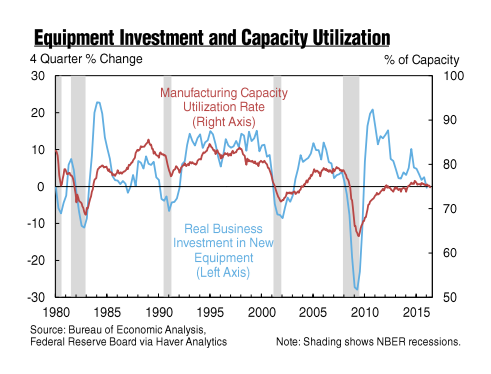
As we know, this prediction of course has not come to pass as according to the most recent New York Fed's snapshot of the US Economy in July:
Over the four quarters ending in 2016 Q1, real business investment in new equipment was down 0.3%, continuing a slowing trend in place since 2010. (...) A key reason for the overall slow pace of growth of investment in new equipment is relatively low level of the manufacturing capacity utilization rate. This rate which had been slightly above 75% for over a year, dipped below 75% in May. Historically, robust growth of investment in new equipment is associated with a capacity utilization rate of 80% or higher.
As we have argued in September last year that :
The Fed's estimate of longer-run normal rate of unemployment is not consistent with the US investment in capital formation, The appearance of a gradual decline in the US economy's slack is attributable to a greater use of contingent labour and contingent capital, due to the prevailing global uncertainty.

The economy is being distorted by the zero-interest rate policy and is not getting closer to its long-term equilibrium. The use of contingent production factors has generated a quasi-closing of the gap in reference to a quasi-potential output growth, which corresponds to Klein (1960) and Berndt and Morrison (1981) definitions of capacity. This is why this quasi-closing of the gap has not exerted an upward pressure on the US inflation rate.
This structural approach would reveal that the question of capacity utilization rate needs to be carefully reevaluated. The nature of full capacity under contingent capital and intensive margin would result in a shift of the full capacity potential to the left along the economy's long-term average cost curve. The resulting short-run equilibrium would be different from the long-term equilibrium capacity. Furthermore we specifically stated that:
How can the labour markets move to equilibrium with such a weak capital formation? It is quite clear that this fragile capital formation is due to the prolonged period in which businesses have postponed investment as a result of the prevailing global uncertainties which have been exacerbated by the authorities suppression of equilibrating market dynamics . Investment spending has grown more slowly than usual for a business-cycle expansion and this is the main reason for the observed decline of the US productivity.

The global uncertainty and ultra-loose monetary policies have encouraged businesses to follow strategies of incremental reductions in costs that are not accompanied by investment in new technology. This has undermined the longer-term growth of potential output, which appears to have caused a distorted and artificial decline in real interest rate, by which authorities hope to encourage entrepreneurs to assume more risk. The economic theory suggests that lack of capital formation would cause a shrinkage in production possibilities frontier, resulting in a decline in labour productivity growth as we have observed in the US

Unfortunately in spite of recognizing that the long-run level of the neutral rate is highly uncertain many analysts, including some of the FOMC members, still focus on it. It appears that some even focus the highly volatile short-term rate. For example, the FOMC's minutes of the June 14-15 meeting reports that:
Many participants commented that the level of the federal funds rate consistent with maintaining trend economic growth—the so-called neutral rate—appeared to be lower currently or was likely to be lower in the longer run than they had estimated earlier. While recognizing that the longer-run neutral rate was highly uncertain, many judged that it would likely remain low relative to historical standards, held down by factors such as slow productivity growth and demographic trends.
It should be clear that it is not slow productivity growth that is holding back (the long-run) neutral rate. The direction of causality is the other way around. The prevailing low interest rate gives the impression that the neutral rate has declined, and at the same time they cause a delay in capital information, via a rise in uncertainty that low rates are causing. Low capital formation reduces the trend productivity, although due to intensive margin operation we may observe some transitory short-term productivity increase. As we have argued in the past, the neutral or natural rate of interest derived from the Wicksellian theory is only valid in the long run general equilibrium conditions. We stated that:
[T]he Wicksellian theory is a general equilibrium theory in which the financial rate of interest that borrowers actually pay must be equalized to the natural rate of interest that is determined by the marginal return on the fully employed real capital. If the financial rate is below the natural rate the demand for investment will rise as businesses can borrow at the lower financial rates and invest the funds into high-returning projects. However, the information signals that a Wicksellian paradigm could emit are not meant for a disequilibrium environment in which the real capital is underutilized and businesses are postponing investment in irreversible fixed capital and opt for waiting.
When due to the prevailing uncertainty businesses refrain from investment and when in their capacity planning they resort to utilizing contingent labour and capital instead of moving towards their long term minimum average cost capacity the Wicksellian equilibrium theory would be an inappropriate analytical framework. In fact, the concept of the natural rate of interest in a disequilibrium environment would be an oxymoron.
-- The introduction to this piece is slightly modified to take into account the Fed's inaction on July 27th.